NEW BOOK
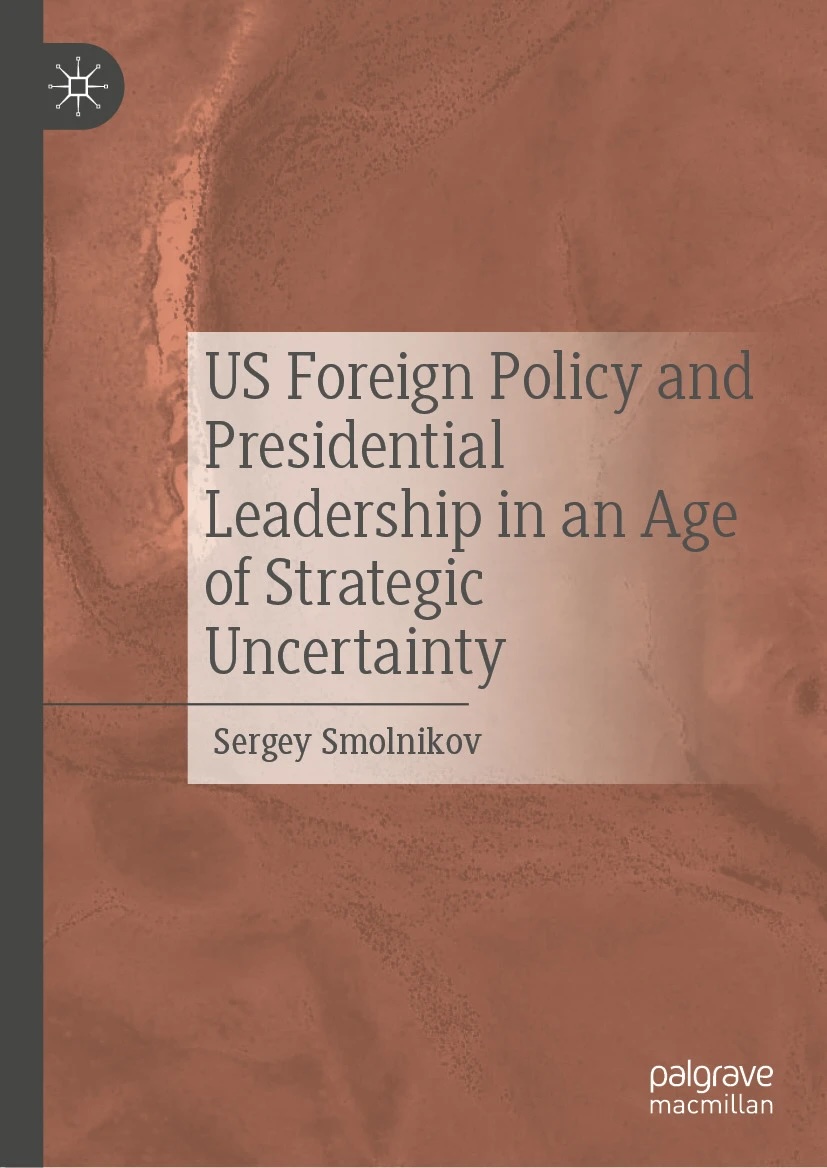
US Foreign Policy and Presidential Leadership in an Age of Strategic Uncertainty
(Palgrave Macmillan, 2026)

Dr. Sergey Smolnikov
Welcome to my website! Its purpose is to familiarize you with my work and scholarly profile. This platform presents my research, publications, and perspectives in the realms of International Relations, International Security, World Order, International Political Economy, Foreign Policy, and Strategic Studies. The website is designed to connect my work with institutions, scholars, and policymakers interested in thorough analysis and original theory in international security and global strategy.
I am an international scholar of strategic studies, foreign policy, and great‑power politics. My life and work span three continents – North America, Europe, and Asia. I held full professorships overseas, and I currently teach International Relations and Strategic Studies in Canada. My research focuses on examining the nature and patterns of structure-agency interaction in shaping global order. By drawing on the knowledge accumulated by various academic disciplines, including sociology, political science, psychology, history, and economics, it seeks to develop conceptual frameworks to account for shifts in the international system that more adequately explain their nature, causality, and patterns.
I am the author of numerous publications in the foregoing realms, including three major single-authored books. My early work conceptualized the European Union as an international actor sui generis. It offered one of the first systematic accounts of the EU’s place and role in the global political-economic system. My second book addressed the conduct of principal powers, including the United States, Britain, France, Russia, and China at different stages of their power cycle. It conceptualized the strategic behaviour of the governing elites in great powers as a stage‑dependent phenomenon, while explicating the links between structural constraints and political will. The book advanced a theory of power credibility that explains how great power elites tend to behave during phases of their nations’ relative decline.
My most recent book is a fundamental study of US statecraft in the first quarter of this century. It examines the foreign policies of the recent American presidencies, including those of Barack Obama, Joe Biden, and Donald Trump. In this almost 600-page volume, substantiated by 40 original tables and figures, I address the commonalities and differences in the leadership styles, personality traits, and strategic thinking of the American presidents in the post-unipolar era. The book develops a unifying criterion – transformative depth – to advance an original taxonomy of US foreign policy factions and streams. It continues the study of the major topic of my scholarly interest – the drivers and mechanisms of great power conduct at inflection points in their respective life cycles. The book explores a variety of illustrative topics ranging from controversies in the United States’ foreign policy toward her allies and foes to attempts to retain American primacy in economic, technological, and military races to Washington’s credibility in various world regions and in particular Europe and the Indo-Pacific. Most importantly, it emphasizes the impact of presidential agency as a consequential structuring force in the international system at times of strategic uncertainty.
